Hong Kong Public Transport
When someone talks about the PRC (People’s Republic of China), we imagine a socialist country with a lifestyle that differs little from the former USSR, of course, with an admixture of Asian flavor. This opinion is partly true, and in many provinces of China, tourists will not see anything interesting except industrial complexes and endless agricultural plantations. However, there is a place in this country that is unlike the rest of China, moreover, this place has no analogues in the world at all. It’s about Hong Kong.
A little bit about geography
Geographically, it is an island bordered by another 260 pieces of land on the coast of the South China Sea.
Formally, Hong Kong is part of the PRC, but it is a special administrative region with autonomy. It was the latter fact and its convenient location for trade that made Hong Kong the pride of the whole of Asia. The former outpost of the British Empire has turned into one of the largest economic centers in the world, a huge trading port, a popular tourist and entertainment center and, of course, an amazing metropolis. On this island, you can easily make a fantastic film about the distant future, as it is a sparkling kingdom of glass, concrete, monumental structures and bright neon lighting.
In the central part, life is bustling around the clock, daytime business activity is replaced by stormy nighttime entertainment, the streets are always very crowded, various vehicles scurry between numerous skyscrapers, and helicopters fly in the sky. Despite the high urbanization and the huge influx of tourists, local authorities monitor the ecology of the city and the cleanliness of the streets. There is a lot of greenery in Hong Kong, there are picturesque parks and artificial reservoirs.
But the main attraction of the city is its unique lifestyle. Hong Kong never sleeps, they either have fun here around the clock, or admire historical sights, or earn money. You don’t get bored in Hong Kong, so if you come to this city, be ready to plunge into a real stream of emotions and impressions. For tourists, there is, perhaps, the widest range of entertainment – from quite standard excursions and shopping to overnight visits to strip clubs or extreme sports. The entertainment industry in Hong Kong has been elevated to the state level as one of the most profitable business areas. However, do not think that the city is trying to bribe tourists only with a round-the-clock schedule and the number of establishments, the quality of service here is also at the highest level. The most comfortable and convenient conditions are created for the guests of the city, as well as for its residents. A striking example is transportation: despite the dense passenger traffic, getting from one area of Hong Kong to another is not so difficult.
This exotic city is densely populated, even by Chinese standards.: At least 7 million people live on the island. The number of visitors and tourists is difficult to calculate, because every day hundreds of thousands of people arrive on the coast for business or entertainment purposes. There are representative offices of almost all well-known airlines in the city, liners and cargo ships are moored in the port. All this huge mass of people use transport to get to their destination or just arrange for themselves a short tour of this beautiful and unusual island.
The epithet “unusual” is mentioned for a reason: Hong Kong is an island and mountainous area, so you can see a wide variety of modes of transport here. Sea ferries run between small islands and connect the central part of the city with the Kolun Peninsula and mainland China, helicopters make private panoramic flights or transport important business guests to specially equipped platforms of high-rise business facilities, and funicular service stretches to mountainous areas. Less exotic modes of transport include the high–speed metro, large and small buses, trams and, of course, the symbol of any metropolis – a taxi. If you intend to visit Hong Kong and at the same time not spend the whole day traveling by public transport, it is worth considering each type in more detail.
So, in most cases, tourists arrive in Hong Kong by plane, they are met by Cheekyongkok International Airport. This facility welcomes not only visitors to the city, but also those who wish to visit mainland China, because this region is the easternmost and is the gateway to Southeast Asia. What is the famous Cheeklapkok Airport, what can tourists expect from it? It is located on a separate island, has two large international terminals and annually passes through up to 50 million passengers. Despite such a huge number of people, the airport is recognized as one of the most comfortable and has many awards for the quality of service. From the airport, tourists can get to the city via a special Airport Express metro line, waiting for a bus at the closed Airport-Mainland Coach Station (more than 250 flights in various directions, including individual tourist ones) or taking a ferry at the SkyPier terminal. Thus, Cheeklapkok Island is an important transportation hub for the entire region, which connects the airport with the Center of Hong Kong, the remote islands of the region and the mainland of China.
MTR
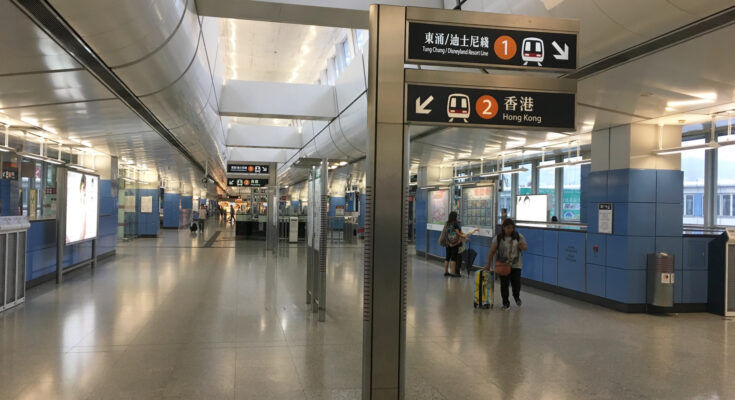
If you are in a hurry and are not interested in bus tours, then the metro is the best choice. Do not be afraid of this type of transport, in Hong Kong it is represented by modern, high-speed and comfortable locomotives, the local subway is not such a dangerous place as its counterpart in New York, Paris or Moscow. Stations of this type of transport can be easily found by a special symbol similar to the Russian letter “Z”. There are not two entrances/exits to one station, there can be up to twenty of them. But tourists will never get lost, as all the signs in this city are duplicated in English, this also applies to the voice notification in the locomotive cars.
There are ten separate subway lines in Hong Kong: Island, Tsuen Wan, Kwun Tong, Tung Chung, Tseung Kwan O, West Rail, East Rail, Airport Express, Ma On Shan and Disneyland Resort. You will travel from the airport using the tourist Airport Express. The branch starts at 05:50 a.m., and the last train departs from the airport at 00:48 a.m. You won’t have to wait long – the interval between arrivals is only 12 minutes. A high-comfort locomotive runs along the branch, it is a very fast electric train moving between stations at a speed of 130 km/h. Thus, it will take no more than 25 minutes to get from Cheeklapkok Airport to the center of Hong Kong. Airport Express cars, as in all other branches, are equipped with air conditioning. What is noteworthy is that the Hong Kong subway is strikingly clean and safe: the handrails and all handles are regularly disinfected, the platform is protected from transport rails by special glass (even above-ground platforms), security personnel are on duty at the stations. In addition to the comfortable atmosphere, guests of the city will be pleased with the availability of a normal mobile connection in the subway, the signal does not disappear, and the locomotive itself moves silently without interfering with the conversation.
As for the cost of such a trip, tourists should know that it is not fixed in the Hong Kong subway. This means that the cost of the trip depends on the distance. The automatic system calculates the cost when you specify the final station and charges it from a special payment transport card. A tourist can purchase metro travel documents or a universal Octopus card. It is worth paying attention to the offers: Tourist Day Pass – one-day full pass for 55 Hong Kong dollars, Child Tourist Day Pass – for 25.
In 2025 The best solution for tourists would be to use the Alipay HK mobile app for all Hong Kong public transport. Read more here: www.hong-kong.su/alipayhk
At the same time, trips on the Airport Express, East Rail Line (first class) and trips to the mainland stations Lo Wu and Lok Ma Chau have their own fares. For the Airport Express branch, you can buy an Airport Express Travel Pass, which will cost 220 and 300 Hong Kong dollars (one trip or two trips to the final destination, respectively). In addition, such a ticket entitles you to ride the main city subway for 3 days for free. If your flight arrived in the morning (from 7 to 10), then the subway fare to the center will cost only HK$ 20, this is a special promotion.
If the system of buying travel documents seemed too difficult to you, then just get an Octopus Card. It is easily replenished, accepted in any form of transport, and can even be used to pay at some fast food outlets. Traveling on the Airport Express branch is also useful because at the stations in the center of Hong Kong (Kowloon and Hong Kong) you can check in in advance (from 1.5 hours to a day). This will save you time if you cannot call the airport.
Buses
Passenger buses are the second most popular mode of transport in Hong Kong after the subway. The city has large trucks of transport companies and minibuses of various sizes. Let’s consider the features of traveling on each of the types.
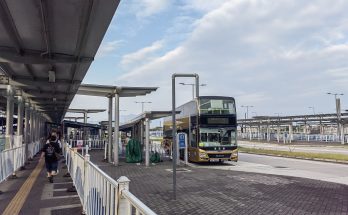
A network of high-quality highways covers the central island itself, the mainland of China, the adjacent Kolong Peninsula and New Territories. Remote islands cannot be reached this way, but there are road bridges and tunnels between the main areas of the city. Regular buses belong to three carriers: Citybus, Kowloon Motor Bus, and New World First Bus. Knowing English, you can easily find out the direction of a particular bus, the final stop is written large on the glass. You can get into a one-story or two-story car, all of them have a comfortable interior and are equipped with air conditioning. Given the heavy traffic, buses are not the fastest way to travel around Hong Kong, but it is on this transport that you can admire the green landscapes and view the unusual architecture of the city. Two-story colossuses with eye-catching advertising images ply the main routes of the city, often stop, and tourists have the opportunity to take photos or look at the endless stream of pedestrians.
On regular Hong Kong buses, the fare also depends on the distance. You make a payment at the entrance, and the driver accepts cash (coins and paper Hong Kong dollars) and the same universal Octopus card.
There are minibuses in Hong Kong that are familiar to Russian tourists, but local minibuses are completely different from domestic ones. First of all, these are comfortable European-made cars designed to accommodate an average of 16 passengers. You won’t see any standing people here, and road safety is strictly enforced in this country, so don’t be surprised by the presence of passenger seat belts.
However, traveling by this type of transport has one important feature that tourists should be aware of before boarding the first minibus they see. There are two types of minibuses in Hong Kong. Green cars are a small type of regular buses. Here you also pay at the entrance at a non-fixed fare and travel along the usual route. A red minibus is a transport with a free route, a kind of “public taxi”. Passengers board it and ride until they want to get off – stops are made here on demand. Such a trip is paid for at the exit, but without knowledge of the local language (Cantonese) and the city, you are unlikely to get to the right place.
How do I find a bus stop in Hong Kong? There are special yellow signs on the sidewalks (regular buses are also often this color), and on the road nearby you can see very large inscriptions in white letters. The markup is written in local characters, but it is also duplicated in English: BUS STOP. The interval between bus arrivals is short, and the timetable indicated on the sign is strictly observed. It is worth noting that traveling on such transport is safe and convenient, you will not encounter drivers who are impolite or careless on the road, since the transportation companies are directly controlled by the municipality of the city.
In order not to make a mistake with the choice of route, navigate the map of Hong Kong, which can often be found at bus stops. Also remember the names of the operators to know where to go: Citybus – the central part of Hong Kong Island, Kowloon Motor Bus – Kolun Peninsula, New World First – New Territories, New Lantao Bus – the center of Lantau Island, Long Win Bus – the north of Lantau Island and the airport.
Tram
If you decide to explore the northern part of Hong Kong Island, which is the business district of the city, or want to visit the vibrant eastern neighborhoods, then it makes sense to take the tram. This type of transport is in itself a landmark in Hong Kong: the tram service of the central district has existed for more than a hundred years. The first rails were laid back in 1904, and the rolling stock has remained unchanged since the 1930s. Of course, some old trams were replaced with modern models, but these analogues were made exactly like historical ones to please tourists. Riding on such an unusual double–decker transport is an amazing entertainment. You will feel the contrast: an archaic tram from the beginning of the last century moves through the streets of a futuristic city made of plastic and concrete. The glass in such a transport is cleaned to a shine, if you take a seat on the second floor, then it is very convenient to admire Hong Kong from such an observation deck.
The pleasure of riding a tram is perhaps the cheapest entertainment in this city. Travel to any point on the route for an adult passenger will cost 2.3 Hong Kong dollars, a child’s ticket costs 1.2, and for the elderly – 1. You can pay the fare to the driver at the front door, when you get off the tram, boarding is done through the back door. Small cash or a universal Octopus Card are accepted.
You can find tram stops by using special signs, there are quite a lot of them on the route, approximately every 250 meters of transport. You won’t have to wait long for the tram, there are plenty of rolling stock on the line, and the waiting interval is no more than two minutes.
If you have definitely decided to take a ride on this unusual type of transport and do not want to get lost, then it is worth remembering the names of the areas through which the six main routes pass. Tourist double-decker trams connect: Shau Kei Wan and Western Market, Shau Kei Wan and Happy Valley, North Point and Shek Tong Tsui, Shek Tong Tsui and Causeway Bay, Happy Valley and Kennedy Town, Kennedy Town and Shau Kei Wan. All signs with the name of the terminal station on trams are duplicated in English.
In addition to the tourist vintage trams in Hong Kong, there is also a modern transport of this type. A branch of high-speed light-rail trams is operating in the New Territories.
Water buses
In general, the island system of the Hong Kong Special Administrative Region has 260 land plots of different sizes. In addition, the bay of the South China Sea divides the city into two large areas – central Hong Kong itself and the Colong Peninsula. There are quite a lot of interesting places for tourists in any of these places, so sea transport is very relevant. Of course, if you suffer from seasickness, you will not be able to fully enjoy a walk on the water surface, the refreshing sea breeze and the magnificent view of Victoria Bay. In this case, take the subway or bus, underground tunnels connect the Kolong Peninsula, mainland China and Hong Kong. However, if you feel like exploring the sea a bit, take the Star Ferry, it’s a guaranteed way to experience a lot of amazing experiences. This service is called the “Star Ferry” for a reason, and you can get especially vivid emotions from traveling in the evening, when Hong Kong lights up its myriad lights. The night lighting of the city is amazing, shining skyscrapers are reflected in the dark sea water, and neon signs cast thousands of bizarre colored rays. Tourists have the opportunity to see such an unforgettable sight, because most sea carriers start ferries almost until midnight.
The most popular route, the Star Ferry, connects Hung Hom and Tsim Sha Tsui stations on the Colong Peninsula with Central and Wan Chai stations in Hong Kong. It is on this waterway that the best view of Victoria Bay opens, a photo of which, perhaps, every tourist visiting Hong Kong has.
Quite old but reliable vessels ply the route. These ferries undergo regular technical inspections and are under the control of the municipal authorities. Their antiquity is manifested only in the absence of increased comfort, there are only standard class seats. But such a boat trip doesn’t last long, and you probably won’t want to be bored when you’re surrounded by one of Asia’s largest port cities. But if you still want to sail at sea in luxury conditions, then more comfortable and faster types of sea ferries run along the routes for tourists, such a trip will cost you more.
In addition to the route connecting Hong Kong and Colong, you can also take a ferry to the remote islands of the region. There are interesting sights, historical monuments and entertainment facilities on them. From the Central Ferry Piers pier in the city center, you can sail to the islands of Peng Chau, Cheung Chau, scenic Discovery Bay, Lantau, Lamma, etc.
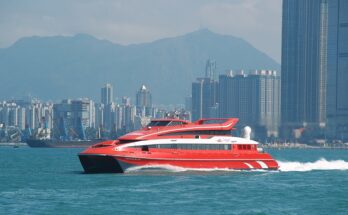
It is also by water transport in Hong Kong that it is easiest to get to Macau Island, which is of interest to tourists. You can also use sea transport to travel to the coast of mainland China. New high-speed ferries operate on these routes. In Hong Kong, they can be boarded at the Hong Kong Macau Ferry Terminal, which is located near Sheung Wan Station. From the Kolun Peninsula, these ferries sail at the China Ferry Terminal pier near Tsim Sha Tsui Station.
In general, the terminals of all the listed routes are very convenient, they are located within walking distance from the central metro stations. There are appropriate signs on the roads specially for tourists, and the berths themselves are clearly visible from afar, so it’s quite difficult to get lost.
As for payment, you can buy a ferry ticket at a vending machine for cash or pay with an Octopus Card. The cost of a sea trip depends on the distance and type of transport, sailing on a high-speed ferry will cost more, and the price of a Star Ferry ticket does not exceed a couple of Hong Kong dollars.
Cable car
If you have already visited the lower coast of Hong Kong and admired Victoria Bay, then it’s time to go to high-altitude Hong Kong and visit the equally picturesque Victoria Peak. Both attractions were named after the English Queen during the reign of the British. Locals prefer to call the peak modestly – “Peak”, it is located in the west of Hong Kong and rises 552 meters above sea level, being the highest point of the island. It is the duty of every tourist to visit the Peak, because you can see the metropolis from a bird’s–eye view from here.
You can take a chance and go hiking, testing your physical fitness, and the mountain is connected to the Center by car. But the most popular way among tourists to get to Victoria Peak is the funicular.
This rather exotic type of transport is called the Peak Tram and is the world record holder for the length of the route. Nowadays, the funicular is open to the public and is a popular form of entertainment, but in the past it could only be used by the British governor. The structure was built and launched in 1888, after which it was repeatedly modernized, despite the fact that the funicular has a vintage look, it is a modern and reliable unit. The trip lasts only eight minutes, and tourists can expect panoramic platforms, restaurants and clubs at the top. If you decide to go to Victoria Peak, don’t forget to bring your camera, Hong Kong in the sun or in the night light is a landscape worthy of a memorable picture.
In the central part of the city, the funicular departs from the Garden Road area, where the Lower Peak Tram Terminus is located. The ticket price is quite reasonable, although more than on other types of transport, you can also use the Octopus Card for payment. It doesn’t take long to wait for the trailer, if you’re late, you’ll only have to stand for 10 minutes.
Taxi
Hong Kong is one of the world’s entertainment capitals, famous for the fact that the fun never ends here, and most establishments are open around the clock. However, as in most cities around the world, Hong Kong’s public transport stops working closer to one o’clock in the morning. The metro is closing, only the last locomotives of remote routes are running, trams and regular buses are leaving for the park, ferries are moored at the berths.
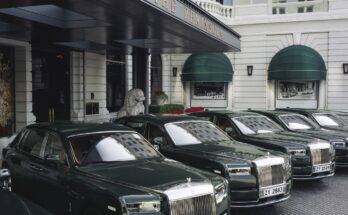
What should I do if I want to visit several clubs or boutiques, go to a restaurant for dinner, or visit a casino? In this case, a taxi is the best option. You can order a similar service during the day, especially if you are in a hurry or are not sure of the location of your destination and only know the address. It is very easy to get a taxi in Hong Kong, there are many of them, cars and drivers are supervised by professional agencies, there are no private cab drivers here. By contacting taxi drivers, tourists may not worry about their own safety, comfort, safety of luggage or the amount of expenses. All cars are equipped with air conditioning, mandatory rear and front seat belts and, of course, a meter. At the end of the trip, the customer is given a receipt, which is important – this receipt contains the personal data of a particular car and driver.
Like all other transportation in Hong Kong, taxis are affordable. The rates depend on the type of carrier operator. There are three such companies in the city, and they differ in the color of the cars. The most common red taxis have the widest coverage, but also the most expensive rates. Such an operator will take you to any part of the central island and the Kolun Peninsula, they do not serve only the Tung Chung Road area and the south of Lantau. A red taxi ride will cost you HK$20 if the distance is up to 2 km. After 2 km, the calculation is carried out at $ 1.5 per 200 meters, when the total amount exceeds $ 72.5 – at $ 1.0 per 200 meters.
Green cars will take you to any area of the New Territories, they work mainly in rural areas. If the distance is up to 2 km, the cost is HK$ 16.5. After 2 km, the calculation is carried out at $ 1.3 per 200 meters, when the total amount exceeds $ 72.5 – at $ 1.0 per 200 meters.
The coverage area of the blue taxis is the entire island of Lantau. Going on a trip for a distance of up to 2 km, you will pay only $ 15, then the calculation will be carried out at 1.3 per 200 meters, when the amount exceeds 72.5 – at 1.0 dollars.
It’s worth knowing that a minute of downtime counts as 200 meters of travel, and each suitcase or large luggage adds $5 to the bill.
A taxi from any of the listed operators can take tourists to the most common points of interest, such as the airport or Disneyland.
And the most important thing. UBER app.
The most convenient way to call a taxi in Hong Kong is through Uber.
You need to link a bank card of a non-Russian bank.
The Cache option is available (a regular taxi will arrive)
I can also order a taxi for you remotely in Hong Kong!
Or order a minivan with a driver for 7 hours in Hong Kong – contact me!
Conclusions. Recommendations
In 2025 The best solution for tourists would be to use the Alipay HK mobile app for all Hong Kong public transport. Read more here: www.hong-kong.su/alipayhk
In general, public transport in Hong Kong can be highly appreciated. The quality of services, comfort, speed, safety and accessibility are the main characteristics of any of the above–mentioned ways of moving around the metropolis.
Of course, Hong Kong, like any other city, has its drawbacks. First of all, these are traffic jams, but you should not compare them with domestic congestion on the roads. Traffic jams in Hong Kong are slow traffic during rush hour, such a phenomenon is unpleasant, but the traffic jams quickly resolve. If you still don’t want to risk being late for a meeting or a plane, choose the subway. The Hong Kong subway system is the most convenient in the world, and electric trains travel at speeds of more than one hundred kilometers per hour. Even traveling from one part of the city to another by metro will not take more than an hour. Also, do not forget about ferries, they are a fast way to travel from Hong Kong Island to the Colong Peninsula or back. There are high-speed vessels on many waterways that help you get to the right place at the right time. Another significant advantage is that Hong Kong has a convenient location for roads and communications, and most modes of transport have alternatives.
Alex iurlov tour guide in Hong Kong, Macau and China
Car transfers, yacht charters.
+85268553629 (WhatsApp, Telegram, Wechat)
Wechat id: iurlov
info@hongkong.su
www.hong-kong.su
www.tour.hong-kong.su
www.yachts.hong-kong.su
www.alphard40.hk
www.yurlov.com – my personal web site